Understanding E-commerce Regulations and Compliance in Bangladesh
Why thousands of digitally active SMEs remain economically invisible despite contributing to the country’s growing commerce ecosystem. 1. The Common Misunderstanding In Bangladesh, conversations around entrepreneurship often focus on one issue: “Startups…
Why thousands of digitally active SMEs remain economically invisible despite contributing to the country’s growing commerce ecosystem.
1. The Common Misunderstanding
In Bangladesh, conversations around entrepreneurship often focus on one issue:
“Startups and SMEs need more funding.”
While partially true, the reality is more complex.
The challenge facing many SMEs today is not only the absence of capital.
It is the absence of systems that make businesses structurally ready for growth, financing, and institutional trust.
Thousands of SMEs across Bangladesh already generate real economic activity every day through:
- ecommerce
- Facebook commerce
- logistics networks
- retail operations
- digital services
- manufacturing
- reseller ecosystems
Yet many remain disconnected from:
- institutional financing
- investment networks
- structured governance systems
- digital financial visibility
- compliance frameworks
As a result, they operate economically active businesses while remaining institutionally invisible.

2. Bangladesh’s Emerging Digital SME Economy
Bangladesh’s digital commerce ecosystem has evolved rapidly over the past decade.
Today’s SMEs are no longer limited to traditional storefront businesses.
A new generation of businesses now operates through:
- social commerce
- ecommerce platforms
- digital marketplaces
- cross-border networks
- creator-led commerce
- AI-assisted operations
This shift has created a massive informal digital economy layer.
However, institutional systems have not evolved at the same pace.
This creates a structural mismatch between:
- how SMEs operate
and - how institutions evaluate them.
3. Why Financing Alone Cannot Solve the Problem
Many discussions assume that increasing loan access or investment availability will automatically solve SME growth barriers.
But financing systems depend on trust infrastructure.
Investors and financial institutions need:
- measurable business visibility
- operational consistency
- governance standards
- financial transparency
- risk assessment frameworks
- verified operational data
Unfortunately, many SMEs still lack these layers.
This does not necessarily mean they are weak businesses.
It often means the ecosystem itself has not yet developed adequate support infrastructure.

4. The Missing Layer: Ecosystem Infrastructure
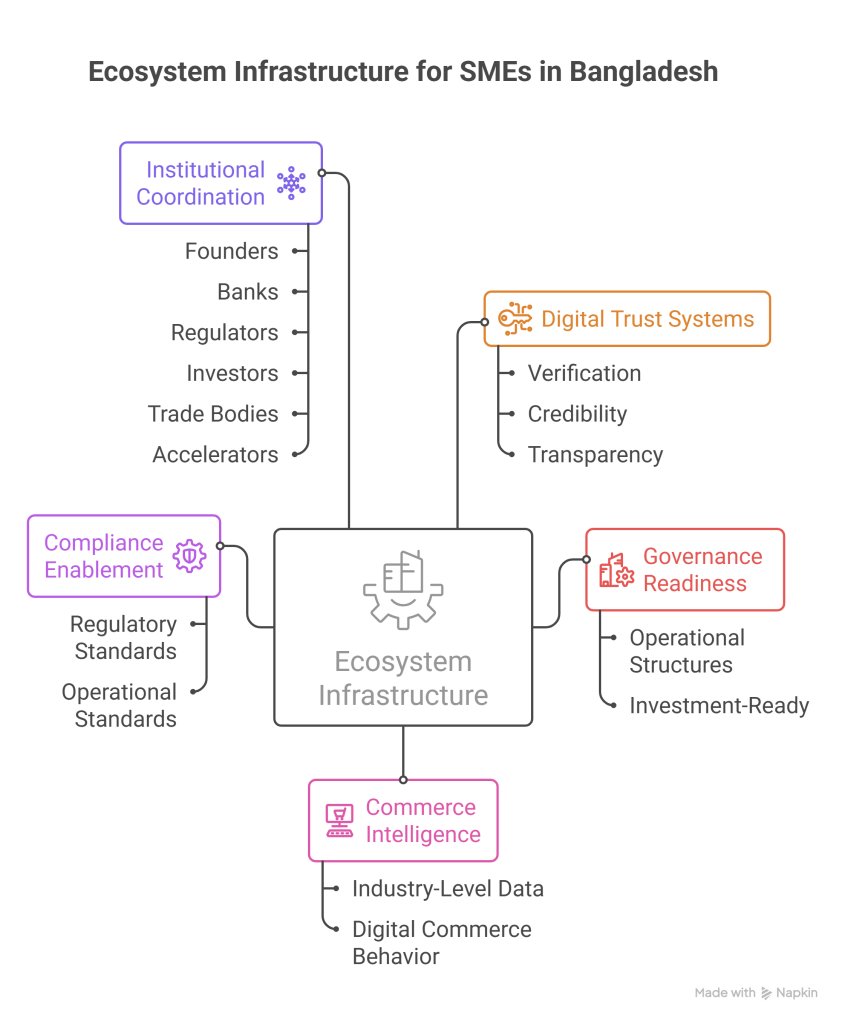
Bangladesh’s next economic opportunity may depend on building ecosystem infrastructure around SMEs.
This includes:
Digital Trust Systems
Systems that improve verification, credibility, and transparency.
Governance Readiness
Basic operational structures that help SMEs become scalable and investment-ready.
Commerce Intelligence
Industry-level data systems that help institutions understand digital commerce behavior.
Compliance Enablement
Helping SMEs gradually align with regulatory and operational standards.
Institutional Coordination
Reducing fragmentation between:
- founders
- banks
- regulators
- investors
- trade bodies
- accelerators
5. Why This Matters for Bangladesh’s Future
SMEs are not a side component of the economy.
They are the operational backbone of employment, commerce, and regional economic participation.
As global commerce becomes increasingly digital:
institutional integration
SME modernization
digital trust
data visibility
cross-border readiness

will become critical national competitiveness factors.
Countries that successfully transform SMEs into structured digital economic participants will likely lead the next phase of regional growth.
Bangladesh still has the opportunity to position itself within that future.
Why do many SMEs in Bangladesh fail to scale?
Many SMEs in Bangladesh struggle to scale not only because of limited funding, but because of weak structural readiness.
Key barriers include:
- Lack of operational systems
- Weak financial visibility
- Limited compliance readiness
- Absence of institutional trust frameworks
This creates a gap between economic activity and institutional recognition.
Why is structural readiness important for SMEs?
Structural readiness helps SMEs become:
- Investable
- Scalable
- Financially visible
- Institutionally trusted
Without operational structure, financing alone often fails to create sustainable growth.
Conclusion
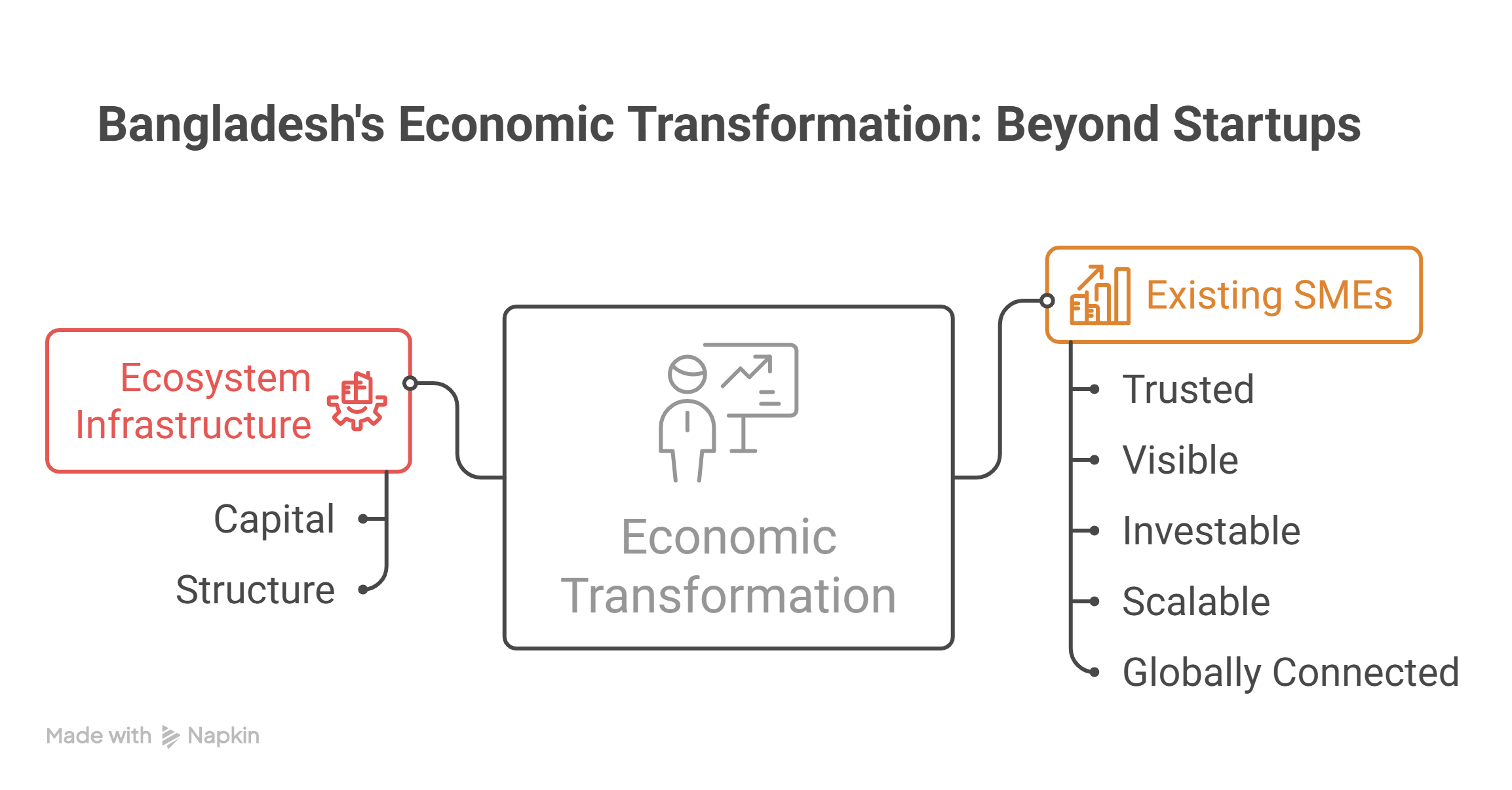
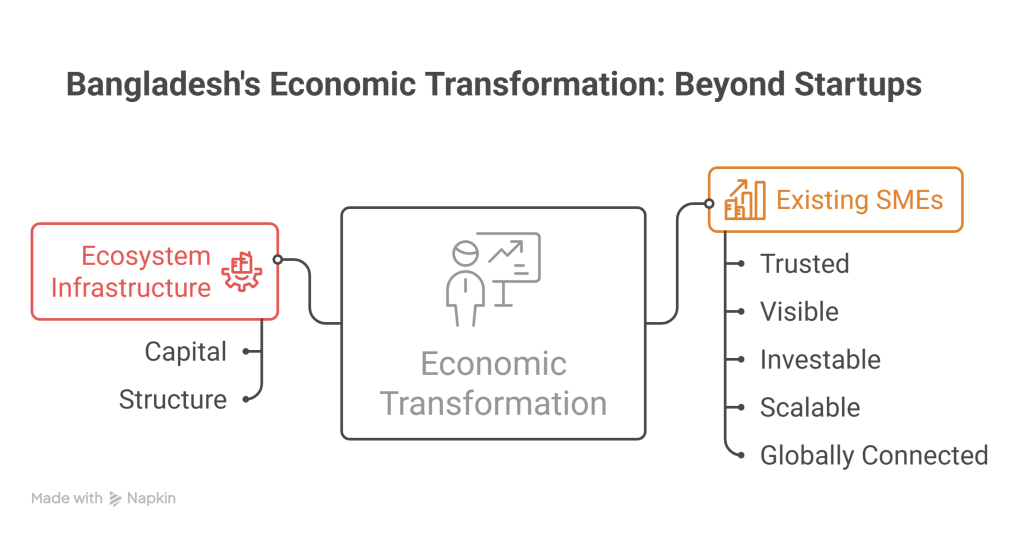
The next phase of Bangladesh’s economic transformation may not come only from creating more startups.
It may come from building systems that allow existing SMEs to become:
- trusted
- visible
- investable
- scalable
- globally connected
Capital is important.
But long-term ecosystem growth requires more than funding.
It requires structure.
Bangladesh has thousands of economically active SMEs, but many remain institutionally invisible due to lack of structural systems.
Sharif Ahmed – Founder, DCIF
📩 Contact
📧 Email: contact@dcif.bd
Read This Relevant Article
Bangladesh’s Digital Commerce Future Depends on Infrastructure, Governance & Trust
📊 To Know The Below
Subscribe Our Newsletter Today
- Digital Trust Infrastructure in Bangladesh
- Why Compliance Matters for SMEs
- The Future of Bangladesh’s Digital Economy