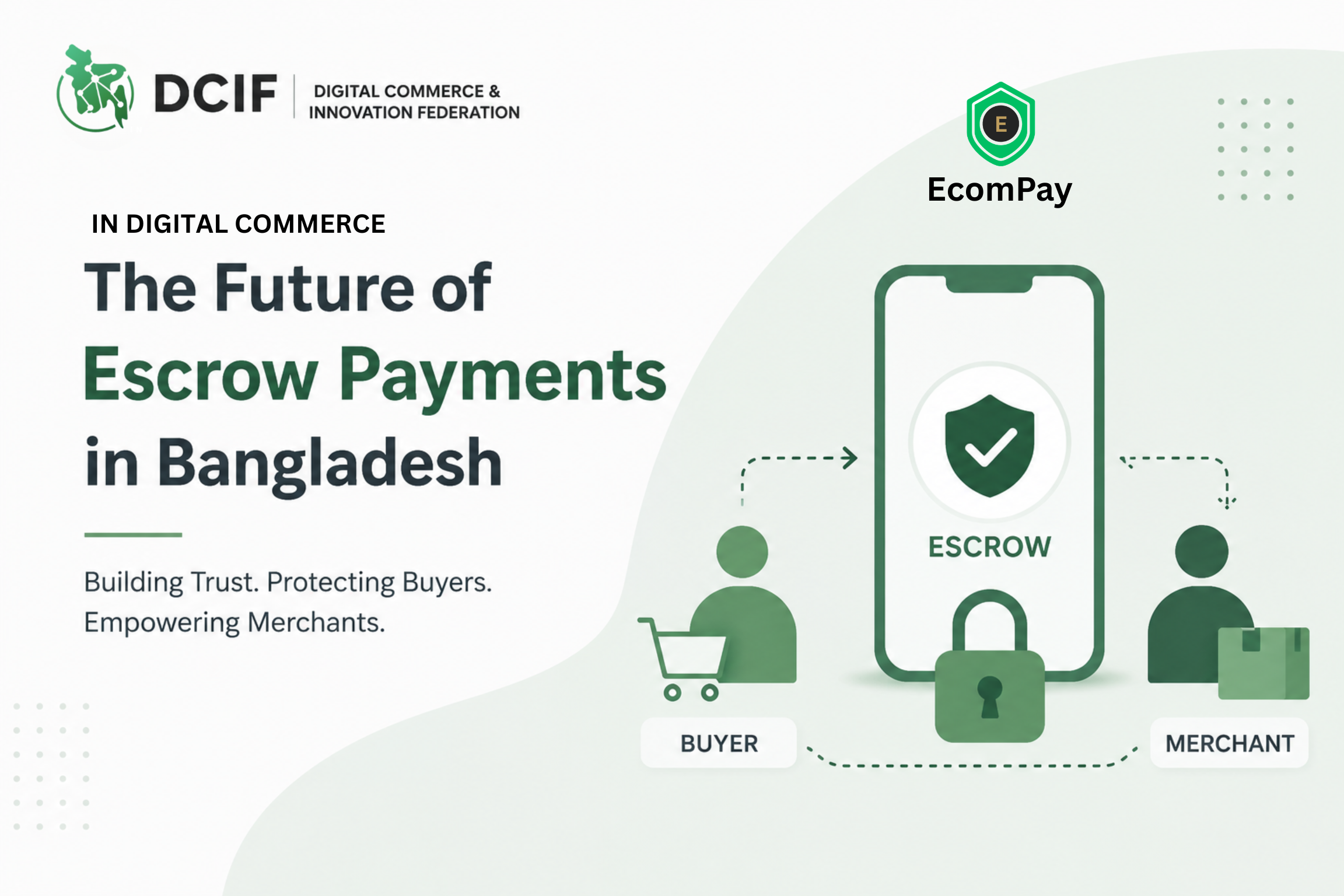
The Future of Escrow Payments in Bangladesh: Building Trust in Digital Commerce
Author: DCIF Research DeskCategory: Digital Commerce Policy & Payment Innovation Bangladesh’s e-commerce industry has experienced remarkable growth over the past decade. Driven by social commerce, mobile financial services, and increasing internet penetration,…
Author: DCIF Research Desk
Category: Digital Commerce Policy & Payment Innovation
Bangladesh’s e-commerce industry has experienced remarkable growth over the past decade. Driven by social commerce, mobile financial services, and increasing internet penetration, millions of consumers now purchase products online every year.
However, despite this growth, several structural challenges continue to limit the industry’s full potential:
- Fake orders
- High return rates
- Consumer trust deficits
- Cash-on-Delivery (COD) dependency
- Payment disputes
- Fraudulent merchants and buyers
As Bangladesh moves toward a more mature digital economy, Escrow Payment Systems may become one of the most important tools for building trust and ensuring sustainable growth.
What is Escrow Payment?
An escrow payment system is a financial arrangement where a third party temporarily holds a buyer’s payment until both parties fulfill agreed conditions.
In simple terms:
Customer pays → Third party holds money → Product delivered successfully → Seller receives payment
If a valid dispute arises, the escrow provider reviews the case according to predefined policies.
This system protects both buyers and sellers.
Why Bangladesh Needs Escrow Payments
The current e-commerce model in Bangladesh heavily depends on Cash-on-Delivery (COD).
While COD helped increase consumer confidence during the early stages of e-commerce adoption, it has also introduced several challenges:
1. Fake Orders
Customers may place orders without intent to receive them, resulting in:
- Logistics costs
- Packaging losses
- Operational inefficiencies
Merchants often bear these costs alone.
2. High Return Rates
Unnecessary returns create:
- Inventory disruption
- Additional courier charges
- Cash flow pressure on businesses
3. Consumer Trust Issues
Consumers remain cautious because of:
- Fraudulent sellers
- Wrong products
- Delivery failures
- Lack of dispute resolution systems
4. Delayed Merchant Payments
Merchants often wait days or weeks to receive COD settlements, affecting business liquidity.
How Escrow Can Transform Bangladesh’s E-commerce Industry
For Consumers
Escrow provides:
✅ Payment protection
✅ Dispute resolution
✅ Increased trust
✅ Safer online transactions
Consumers become more willing to pay online when they know their money is protected.
For Merchants
Escrow enables:
✅ Reduced fake orders
✅ Better cash flow management
✅ Higher prepaid order rates
✅ Stronger customer trust
Over time, businesses can reduce their dependence on COD.
For the Industry
Escrow helps create:
✅ Standardized transaction processes
✅ Transparent digital commerce
✅ Lower fraud rates
✅ Sustainable ecosystem growth
A Hybrid Escrow Model for Bangladesh
Bangladesh may not immediately transition from COD to full escrow.
Instead, a Hybrid Escrow Model may be more practical:
Possible Framework:
Level 1: Verified Merchants
DCIF-verified merchants receive escrow access.
Level 2: Partial Advance Payment
Customers pay:
- Delivery charge only, or
- 20–30% advance payment
The remaining amount is paid after delivery.
Level 3: Full Escrow Transactions
As trust grows, more transactions can move to full escrow.
This gradual approach reduces friction while encouraging responsible behavior.
The Role of Merchant Verification
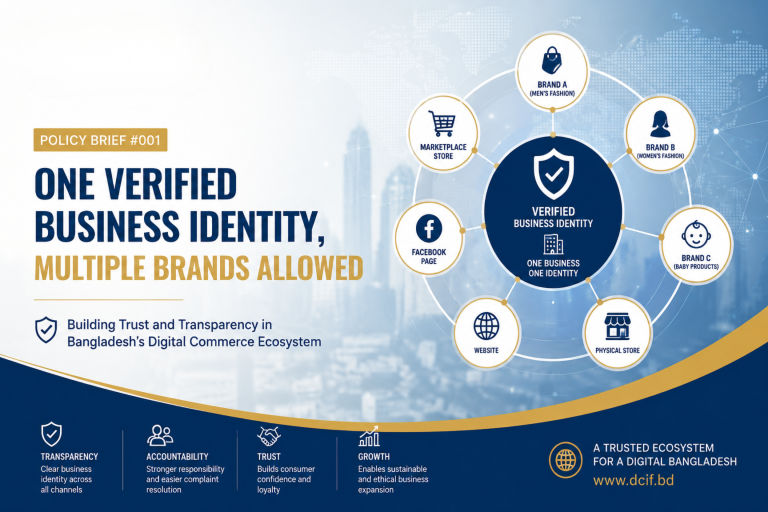
Escrow works best when combined with merchant verification systems.
A trust-based ecosystem requires:
- Merchant identity verification
- Business validation
- Performance monitoring
- Customer review mechanisms
Verified merchants create greater confidence for consumers.
Beyond Payments: Building a Trust Infrastructure
Escrow is not just a payment mechanism.
It is part of a broader Digital Commerce Trust Infrastructure, which may include:
- Merchant Verification
- Verified Reviews
- Dispute Resolution
- Delivery Standards
- Consumer Protection Policies
Together, these systems create a healthier marketplace.
Challenges to Adoption
Despite its potential, escrow implementation in Bangladesh may face several challenges:
Regulatory Framework
Clear regulations are necessary to define responsibilities and dispute resolution processes.
Technology Integration
Payment gateways, banks, MFS providers, and marketplaces need interoperability.
Consumer Awareness
Users must understand how escrow works and why it benefits them.
Industry Collaboration
Successful implementation requires collaboration among:
- Merchants
- Logistics providers
- Payment companies
- Industry associations
- Regulators
EcomPay: Building the Foundation for E-commerce Escrow in Bangladesh
As Bangladesh’s digital commerce ecosystem continues to grow, the demand for secure and trust-based payment solutions is becoming increasingly important.
EcomPay is an emerging initiative that aims to explore and develop escrow-based payment solutions specifically designed for the e-commerce industry in Bangladesh.
The vision behind EcomPay is simple:
- Reduce fake orders and payment disputes
- Increase trust between merchants and consumers
- Support verified merchants through secure transactions
- Encourage digital payments while gradually reducing excessive dependence on Cash-on-Delivery (COD)
- Create a stronger foundation for a transparent and accountable e-commerce ecosystem
Unlike general payment gateways, EcomPay is being conceptualized with a dedicated focus on the unique challenges faced by e-commerce businesses, including returns, delivery disputes, merchant verification, and consumer trust.
While the platform is currently in the development and exploration stage, it reflects a broader industry movement toward building a safer and more sustainable digital commerce environment in Bangladesh.
If successfully implemented, escrow-based solutions such as EcomPay could play a significant role in strengthening trust across the entire e-commerce value chain.
The Future Outlook
Bangladesh’s digital economy is evolving rapidly.
As online commerce becomes increasingly sophisticated, trust will become one of the industry’s most valuable assets.
The future of e-commerce may not depend solely on faster deliveries or larger marketplaces it may depend on building systems that create confidence between buyers and sellers.
Escrow payments represent one such system.
DCIF Perspective
At DCIF, we believe that a trust-based digital commerce ecosystem requires more than technology. It requires standards, accountability, and collaboration.
Escrow payment systems combined with merchant verification, review mechanisms, and industry guidelines have the potential to strengthen Bangladesh’s digital commerce landscape and support its transition from local growth to global competitiveness.
DCIF believes that trust infrastructure not discounts is the future of digital commerce. Merchant verification, consumer protection, transparent reviews, and escrow-enabled payments will be key pillars of a sustainable e-commerce ecosystem. EcomPay is one of the initiatives being explored to support that vision.
Key Takeaway
The future of e-commerce is not only about selling online—it is about building trust at scale.
FAQ Section
What is an escrow payment system?
An escrow payment system holds a buyer’s payment with a trusted third party until the product or service is successfully delivered.
Why is escrow important for Bangladesh’s e-commerce industry?
Escrow reduces fraud, fake orders, payment disputes, and increases consumer trust in online transactions.
Can escrow reduce COD dependency?
Yes. Escrow provides payment security similar to COD while allowing digital payments, helping businesses gradually reduce cash-on-delivery reliance.
How does escrow protect consumers?
Consumers know their money is protected until they receive the correct product as promised.
How does escrow benefit merchants?
Merchants receive verified orders, fewer fake orders, better cash flow predictability, and increased customer trust.
Will escrow become mandatory in Bangladesh?
While not mandatory today, industry experts believe escrow-based payment systems will become increasingly important as the digital commerce ecosystem matures.
What is DCIF?
DCIF (Digital Commerce & Innovation Federation) is a private-led initiative focused on trust, innovation, compliance, and sustainable digital commerce ecosystem development in Bangladesh.
Why is merchant verification important?
Merchant verification improves transparency, accountability, and consumer confidence while reducing fraud risks.
📩 Contact
📧 Email: contact@dcif.bd
Read Relevant Article From DCIF Policy Briefs
What is Merchant Verification in E-commerce?
Why Bangladesh Needs Escrow-Based Commerce Infrastructure
The Future of COD Governance in Bangladesh
Digital Commerce Trust Score (DCTS): A Framework for Responsible Growth
📊 To Know The Below
Subscribe Our Newsletter Today
The Future of Bangladesh’s Digital Economy
Digital Trust Infrastructure in Bangladesh
Why Compliance Matters for SMEs